
 Andy Hunt
The real estate business has dramatically shifted to one driven by word of mouth to one driven by online advertising. Increasingly, real estate professionals report that a large fraction of their leads come inbound via web contact forms, Zillow, Trulia, Yelp, etc and less from word of mouth referrals.
Yet, real estate professionals are not trained in online advertising or in customer acquisition – they are trained in real estate! Most are extremely good at what they do, but when it comes to marketing, many are looking for help.
In this week’s post, we’ll cover five real estate marketing tips with practical implementations on how to implement.
1. Optimize your Contact Forms
The overwhelming majority of real estate firms contact forms are not optimized for conversion. Typically, they lose somewhere between 20% and 40% of potential leads because these forms simply ask for too much information and aren’t well-designed.
Here’s an example of a contact form from a real estate firm in Austin:

Do you see what’s wrong here? Many real estate agents have never heard of conversion rate optimization for AB Testing, but for experienced online marketers, there are obvious things here:
- Too many fields: For every field you ask customers to complete, you decrease response rate by about 5-10%. That means that cutting 5 fields from your contact page can increase your lead volume by 25-50%. Some real estate firms try to “qualify” leads by forcing them to complete several steps, but this is almost always a bad idea – you will lose potentially qualified customers by forcing them to jump through hoops.
- No value to customer: What does a customer get by filling out a form? Instead of a simple contact us link, try adding a free evaluation or free housing tour in order to get people interested. Even if this is low cost, getting something for “free” will motivate more customers to get in touch.
Optimizing forms is simple but can add a demonstrable increase in leads for any real estate business.
2. Take Reviews Seriously
Reviews on Yelp, Google Places & Zillow can make or break the B2C side of the real estate business, such as people looking to sell or buy a home. Many customers today feel more comfortable researching their potential real estate partner online first rather than simply relying on good word of mouth recommendations.
You’ll find that Yelp and Google Places are particularly competitive for real estate. Here’s an example from Austin, where the top agents have 50-100 reviews each:

Getting 50-100 reviews takes time but is not impossible. If your team is conducting 10-20 transactions a month and can politely encourage customers to share feedback on the web, it’s possible you can be there. Apps like Testify can help you increase review volume; however you need to be very careful not to overdo it as Yelp doesn’t like when businesses are aggressive in soliciting reviews.
3. Use Testimonials & Success Stories
Customer testimonials are often what can bring a client over the edge when deciding between two real estate firms that seem equally qualified. B2B firms (such as brokers or investment firms) can sometimes use testimonials effectively, but I find that project success stories or investment success stories are far more powerful pieces of marketing collateral.
Here’s a great example of testimonial use from Give Realty here in Austin:
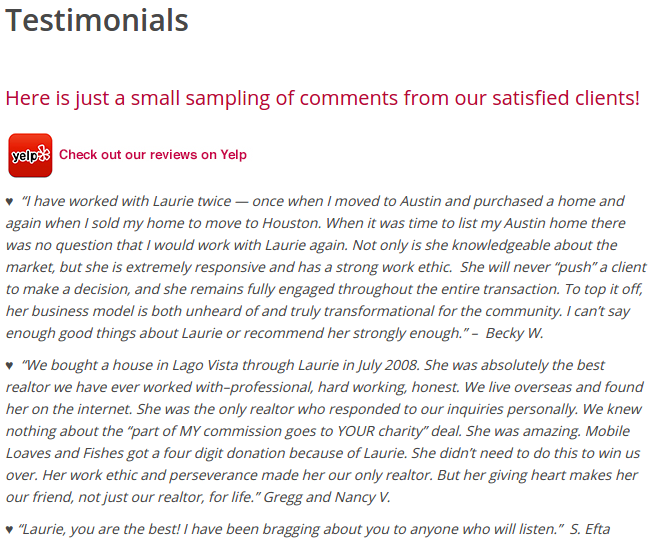
Each of these testimonials tell a story and it’s more than enough to add that extra “punch” to turn a prospect into a customer. Of course, I’m a big fan of automating your testimonial and review collection process, but I’m biased 🙂
Success stories also are very effective. CREO has a good collection of success stories on their site and the content is effective, but I’d argue that you want a more effective presentation to really make these professional.
4. Authoritative Content Marketing
Content marketing is no longer just about blogging. Instead, a more effective approach is to find an angle or niche within real estate that you alone cover.
For example, for the Austin market, a great piece of content would be data around the real estate market:
- What will the Austin market look like in 10 years?
- What’s been the average ROI for a real estate investor in the Austin market over the past 10 years?
- How long is the average property on the market?
- How competitive is the real estate business? Are firms competing against each other, or are there enough buyers and sellers to go around?
While there are several blogs about real estate, most do not go in depth enough to generate enough traffic or establish enough authority to make a dent in your business.
5. Unique Selling Proposition
Finally – what is it about your particular real estate business that makes it unique? Why should buyers choose you over someone else?
Again, my hat is off to Give Realty, whose unique value proposition is not only the first I’ve seen but also stated clearly on its website:
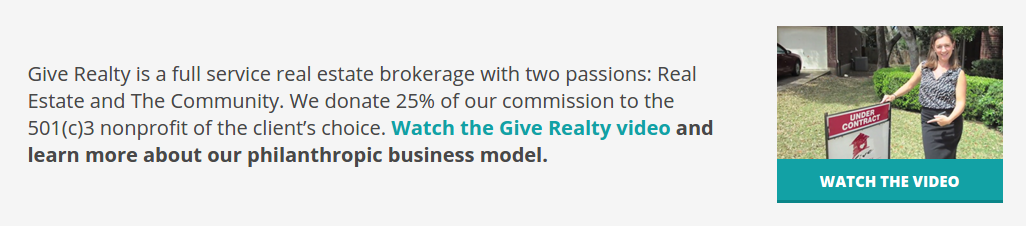
What other real estate firm do you know that will put 25{feedfbebd23b38ce627264ab3bf279ff2e9cbb40f5ce0421014ba6b273a58124} of commission right back to charity, having donated $500K total? Now that is different and valuable! It certainly makes me feel different about my real estate purchase.
Summary
Real estate marketing is unique in that it blends traditional online marketing with old school offline marketing tactics. Start by focusing on the basics to optimize your online presence, and then move into more advanced solutions until you’ve got your story down.
If we missed any tactics, please add in the comments below!